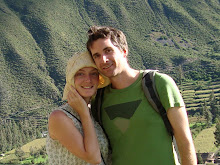
I was much more comfortable on terra firma, than I was climbing 30 feet up a ladder in strong winds to the rusty, old viewpoint (below).
We spent last week staying with a family in a community called Sontule up in the mountains in the north of the country. The whole area is now a nature reserve which should help prevent more deforestation. Most families have small plots of land growing coffee, in amongst banana plants and jungle-like forest. The scenery is stunningly beautiful with undulating green mountains, covered in forests and dotted with rural houses and farms for as far as you can see. We have failed to capture this in any of our photos but hopefully, Simon will do so at some point as, from next week, he's going to be spending three days per week here teaching English to children and a youth group that wants to learn English for tourism.
The 'village' is set around a big hill. It takes about an hour and a half with lots of walking up and down to circumnavigate it.  The houses are all spread out and have no mainline electricity or running water. Better off families have houses with several rooms built with concrete breeze blocks and tin roofs; poorer houses look like they only have one or two rooms and are built from mud, wood and straw, maybe with an old tin roof. The toilet is a drop loo, smelly affair at the bottom of the garden.
  The toilet. Not too bad first thing, but full of big, buzzing flies by midday. More bearable with the door open.
 The houses are all spread out and have no mainline electricity or running water. Better off families have houses with several rooms built with concrete breeze blocks and tin roofs; poorer houses look like they only have one or two rooms and are built from mud, wood and straw, maybe with an old tin roof. The toilet is a drop loo, smelly affair at the bottom of the garden.
  The toilet. Not too bad first thing, but full of big, buzzing flies by midday. More bearable with the door open.
 The view from our bedroom window of a coffee plant with green beans, they should be ripe and ready for picking come December.
There's one bus a day to the community when it's not too wet, otherwise it's walking here from another bus route two hours away, or horseback. There was lots of rain while we were there, so much so, that to get back down to Esteli, the bus had to stop and put chains on the wheels to stop it sliding off the muddy tracks and down the mountain.
As seems to be the case in the countryside here, most people are related to one another in some way and extended families either live together or opposite one another. We stayed with Don Rogelio and his wife Dona Lucia and their youngest son, Rogelito. Their other children, brothers and sisters, and nieces and nephews, all live nearby and drop in regularly. Simon in his borrowed jumper to stave off the morning and evening chill in the mountains, with Dona Lucia, Don Rogelio, and two of their sons, Rogelito and Marlon.
 Simon in his borrowed jumper to stave off the morning and evening chill in the mountains, with Dona Lucia, Don Rogelio, and two of their sons, Rogelito and Marlon.
 The slightly better off families, like the one where we stayed, have a solar panel which powers a tv with a terrible reception for a couple of hours in the evening, when everyone gathers around to watch very melodramatic Colombian soaps. The kitchen is in a separate building to the house and meals (rice, beans and tortilla are the staple foods) are cooked using firewood.
The village has a small scale tourism project, which consists of a trickle of tourists coming up, staying with local families and getting to know the community. We realised when we arrived that 'getting to know the community' was a bit vague, and we weren't really sure what we were going to do with ourselves for the week. In the downpours of rain, I was beginning to resign myself to reading my book for the week.  However, things seem to have a way of working themselves out in Nicaragua. Particularly as it seems to take so long to do anything by my usual standards (e.g. 1 hour waiting while the chains are put on the bus half way down the hill; 40 minutes walking to reach the one shop in the village; 20 minutes trying to work out how to get water out of the well to have a shower and 10 minutes psyching ourselves up to tip the freezing water over our heads whilst squatting in an outdoor cubicle in the rain).
  View from the kitchen to the rarely used outdoor oven with the pig, roosters and hens pottering around.
 However, things seem to have a way of working themselves out in Nicaragua. Particularly as it seems to take so long to do anything by my usual standards (e.g. 1 hour waiting while the chains are put on the bus half way down the hill; 40 minutes walking to reach the one shop in the village; 20 minutes trying to work out how to get water out of the well to have a shower and 10 minutes psyching ourselves up to tip the freezing water over our heads whilst squatting in an outdoor cubicle in the rain).
  View from the kitchen to the rarely used outdoor oven with the pig, roosters and hens pottering around.
Days start and end early in the countryside to make the most of the daylight. Most people are up by 5.30am and in bed by 8.30pm. Nicarauguan breakfasts are savoury, typically consisting of rice and beans (gallo pinto), sometimes with a grisly piece of meat. Dona Lucia was fond of the frying pan and on our first morning prepared for us deep fried tortillas stuffed with cheese, accompanied by a fried egg. I couldn't cope with this for anymore mornings so I played the foreigner card. This was fine, I think Dona Lucia concluded that we were typically odd and on subsequent days we given a less hearty, but more digestable biscuit/stale bread and fresh mangoes with black coffee that was only bearable after about 3 teaspoons of sugar.  Other meals were far more delicious, a highlight being a fritatta made from various vegetable leaves, herbs, egg and flour. Hopefully Simon will learn how to make it.
  The family's pig, with a wooden, crossed contraption around its head. I haven't spotted a use for this yet but there must surely be one.
 Other meals were far more delicious, a highlight being a fritatta made from various vegetable leaves, herbs, egg and flour. Hopefully Simon will learn how to make it.
  The family's pig, with a wooden, crossed contraption around its head. I haven't spotted a use for this yet but there must surely be one.
We soon got stuck in to weeding the vegetable patch and learning about different plants and herbs; going to the local school and teaching the hokey cokey to 6 year olds in their haphazard PE lesson; attempting to teach a Spanish class (oh dear) and maths to troubled children who the teacher preferred to separate from the rest; going to a workshop run by a feminist organisation on self-esteem in which, much to my amusement, whilst worringly everyone else took him seriously, Simon proclaimed in a group exercise that his character defect was being 'dangerous' (peligroso) rather than his intended one: 'lazy' (perezoso); getting lost in the hills trying to find viewpoints; going to introduce ourselves to a heavily pregnant lady a few miles away who we had heard had an inspiring vegetable patch. All in all, it was a great week and I feel pretty envious of Simon going back there each week.  Part of the family's beautiful, flower-filled garden.
 Part of the family's beautiful, flower-filled garden.